
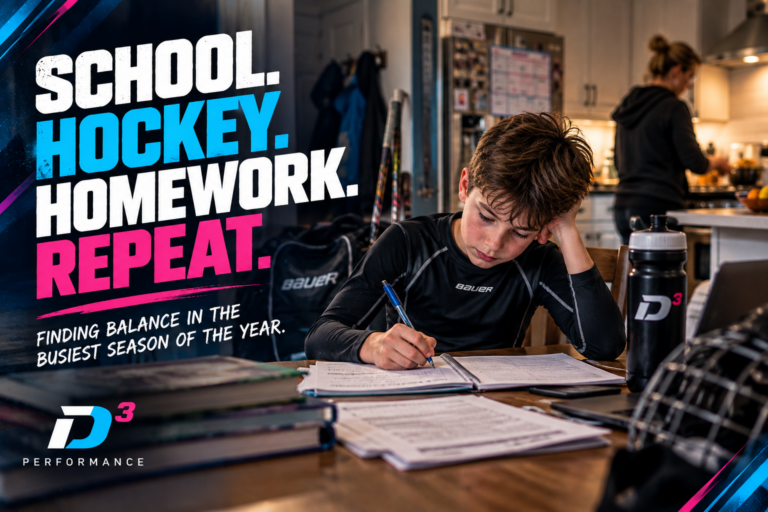
Because developing a great hockey player should never come at the expense of developing a happy, healthy kid.
It’s 4:30 p.m.
Your child just got home from school. There’s homework to finish, dinner to figure out, a hockey bag that may or may not have been unpacked from the last practice, and you’re supposed to be at the rink in an hour.
Sound familiar?
For hockey families, the season can feel like one continuous race between classrooms, arenas, laundry rooms and drive-thrus.
And while hockey provides incredible opportunities for young athletes to grow, learn and develop, balancing those commitments with school, family and everyday life isn’t always easy.
The good news?
Balance doesn’t mean doing everything perfectly. It means figuring out what works for your family, recognizing when something needs to change and remembering what matters most.
Between practices, games, tournaments and additional development opportunities, hockey can quickly take over the family calendar.
A little planning can make a big difference.
At the beginning of each week, take a few minutes to look at what’s coming up.
Which nights have practices or games?
Are there tests, assignments or school projects due?
When will homework realistically get done?
Are there opportunities for downtime?
Does the family have any evenings without commitments?
Sometimes, simply seeing the entire week laid out helps prevent that last-minute scramble.
The goal isn’t to fill every available hour. It’s to make sure there’s enough room for everything that matters.
There’s no perfect homework schedule for young athletes.
Some kids do their best work immediately after school. Others need a snack, some downtime or physical activity before they’re ready to concentrate.
What matters is finding a routine that works consistently.
For younger players, that might mean completing a short homework assignment before heading to the rink.
For older athletes, it could mean planning larger assignments around practices and tournaments rather than leaving everything until Sunday night.
One thing worth remembering:
A tired child struggling through homework at 9:30 p.m. isn’t necessarily learning more because they’re staying up later.
When schedules become overwhelming, it’s worth reassessing commitments and communicating with teachers when appropriate.
This is something we talk about often at D³ Performance.
It’s easy to assume that the players spending the most time on the ice are the ones developing the fastest.
But development isn’t measured by how many hours appear on a schedule.
It’s about what players are learning, how they’re applying those skills and whether they’re physically and mentally prepared to benefit from their training.
A player who arrives at the rink exhausted, distracted or overwhelmed may struggle to get the same value from a session as someone who’s rested, focused and excited to be there.
That doesn’t mean additional development isn’t valuable.
It means quality, purpose and timing matter.
Sometimes, one focused development session is more beneficial than adding several extra commitments to an already packed week.
Between early-morning practices, late games and weekend tournaments, hockey can interfere with regular sleep routines.
And while the occasional late night is part of the experience, consistently sacrificing sleep can affect concentration, mood, learning and athletic performance.
Recovery also goes beyond sleep.
Young athletes need opportunities to relax, spend time with friends, enjoy other activities and simply be kids.
Not every free afternoon needs to become another training opportunity.
Rest isn’t time away from development. It’s part of development.
One of the greatest benefits of organized sports is the opportunity to develop life skills.
Hockey can help young athletes learn responsibility, organization, accountability and time management.
But those lessons don’t happen automatically.
Give players age-appropriate responsibilities.
Younger athletes might be responsible for packing their water bottle, checking that their equipment is ready or remembering their school bag.
Older players can begin managing their schedules, tracking assignments and preparing their equipment independently.
Will they forget something occasionally?
Probably.
But learning to take responsibility is part of growing up.
And those lessons extend well beyond the rink.
Not every child will tell you when they’re overwhelmed.
Sometimes, the signs are more subtle.
A player who normally loves hockey may suddenly seem uninterested in going to practice.
A child who usually manages schoolwork well may begin struggling to concentrate.
You might notice increased irritability, frequent complaints of tiredness, changes in sleep or a lack of enthusiasm for activities they previously enjoyed.
These signs don’t automatically mean hockey is the problem.
But they can be a reason to check in.
Ask how they’re feeling.
Listen without immediately trying to solve everything.
And be willing to adjust the schedule if necessary.
Sometimes the most productive thing you can do for your athlete is take something off their plate.
Hockey creates incredible memories.
The road trips. The friendships. The tournaments. The early mornings that somehow become stories everyone laughs about years later.
But family life shouldn’t revolve exclusively around the rink.
Make time for the things that have nothing to do with hockey.
Movie nights.
Birthday parties.
Playing outside with friends.
Family dinners that don’t involve eating in the car.
Those moments matter too.
A balanced childhood gives young athletes experiences, relationships and interests that help shape who they become beyond the sport.
It’s easy to get caught up in the next game, the next tournament or the next opportunity.
But youth hockey is a long journey.
There will be great seasons and difficult ones.
There will be periods of rapid improvement and times when progress seems slower.
There will be opportunities worth pursuing and others that simply aren’t the right fit for your family.
And that’s okay.
The goal isn’t to raise a child who never misses a practice. It’s to raise an athlete who learns to work hard, manage responsibilities, enjoy the game and develop a healthy relationship with sport.
At D³ Performance, we believe meaningful development goes beyond skating, shooting and puck control.
It’s about helping young athletes build confidence, make decisions, embrace challenges and develop habits that serve them both on and off the ice.
We understand that hockey families are busy.
That’s why we believe development opportunities should be purposeful, flexible and focused on helping players make the most of the time they spend training.
Because at the end of the day, we’re not just developing hockey players.
We’re helping develop young people.
Whether your athlete is looking to build confidence, improve specific skills or complement their regular team training, D³ Performance offers development opportunities designed with purposeful progression in mind.
Our Development Packs also provide families with flexibility, allowing sessions to be shared between players in the same immediate family.
EXPLORE D³ DEVELOPMENT PROGRAMS
Not sure which option fits your player’s schedule, age or development goals? Reach out to us. We’re happy to help you find the right fit.
Develop. Drive. Dominate.
D³ Performance — Developing the player beyond the game.
PUCK—IT uses cookies and similar technologies to improve website functionality, analyze website traffic, and enhance the user experience. Cookies help us understand how visitors interact with our website and allow certain features to function properly.
Users may manage cookie preferences through their browser settings; however, disabling cookies may affect the functionality of some portions of the website.
By continuing to use our website, you consent to the use of cookies in accordance with this Privacy Policy.
Darryl Lloyd brings more than 15 years of professional playing experience and over a decade of player development expertise to the ice. A Pickering, Ontario native, Darryl developed through the OHL with the Windsor Spitfires before earning an NHL Rookie Camp invitation with the Nashville Predators.
His professional career spanned North America and Europe, including time in the AHL, ECHL, and five championship-winning seasons with the Belfast Giants of the Elite Ice Hockey League (EIHL). Along the way, he earned recognition as Team MVP, Forward of the Year, and Hardest Working Player—awards that reflect the compete level, leadership, and work ethic that defined his career.
Today, Darryl shares that experience with the next generation of athletes through a development philosophy built around seven core pillars of the game: skating, puck control, passing, shooting, hockey IQ, compete level, and body positioning. His coaching focuses on developing efficient habits, improving decision-making, and helping players understand how skills transfer into real game situations.
Known for his energetic approach and ability to connect with players, Darryl creates a challenging and positive environment where athletes are encouraged to compete, think the game, and build confidence. He believes that long-term success comes from mastering the details—whether that’s puck protection, body positioning, awareness, or making the right play under pressure.
Having experienced every stage of the hockey pathway—from minor hockey and junior hockey to professional hockey and championship teams overseas—Darryl understands what separates talented players from successful players. His goal is to help athletes become not only better hockey players, but more confident, resilient competitors both on and off the ice.
Fun Fact: Darryl’s professional career took him across two continents and multiple leagues, where he captured five championships and built a reputation as one of the hardest-working players on every team he played for.