
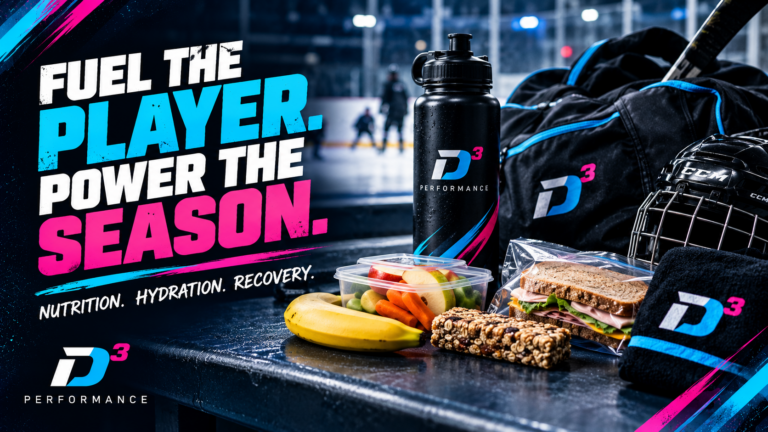
Two Months In: Are We Fuelling Our Young Hockey Players for the Season?
Good hockey development doesn’t start when players step onto the ice. It starts with the everyday habits that help them feel, learn and perform at their best.
We remind our kids to pack their skates, sticks and jerseys.
But are we giving the same attention to the food and water that help them get through school — and onto the ice?
We’re now a couple of months into hockey season. The excitement of the first practices and games has settled into the regular routine of school, homework, team commitments, tournaments and additional development.
For many families, the calendar is already full.
And somewhere between the final school bell and the drive to the rink, one important part of an athlete’s routine can become an afterthought: nutrition and hydration.
It’s easy to focus on ice time, equipment, skill development and performance. But young athletes need more than good coaching and extra practice to get the most out of their season.
They need consistent fuel.
Food and hydration aren’t just about game-day performance. They’re part of supporting growing bodies, everyday energy, concentration, recovery and overall health.
Here are some practical ways hockey families can make fueling a little easier throughout the season.
One of the biggest challenges for young hockey players is that their athletic commitments don’t begin when they arrive at the rink.
Their day might start with an early school morning, continue through several hours of learning and finish with an evening practice or game.
By the time they get to the arena, they’ve already used plenty of energy.
That’s why nutrition needs to be considered throughout the day.
Breakfast, lunch and school snacks all play an important role in helping young athletes maintain energy and concentration.
A few practical ideas include:
The key is consistency.
Waiting until just before practice to eat a substantial amount of food can leave players feeling uncomfortable or under-fuelled.
A little planning earlier in the day can make a significant difference.
Not every hockey day looks the same.
A player heading to a 6:00 p.m. practice has different scheduling needs than someone playing an early morning game or participating in a weekend tournament.
The important thing is to avoid leaving nutrition until the last minute.
Before hockey:
Players generally benefit from having a meal a few hours before activity, with a lighter snack closer to ice time if they’re hungry.
Good options include:
The goal is to provide energy without making players feel overly full or uncomfortable.
After hockey:
Once practice or a game is finished, it’s important to replenish energy and support recovery.
A meal or snack containing carbohydrates and protein can help.
Some easy options include:
And remember, young athletes don’t need complicated recovery products or expensive sports nutrition products to build good habits.
Regular, balanced food is an excellent place to start.
Hydration is one of those things that’s easy to overlook.
Players grab their water bottles before practice, take a few drinks during breaks and sometimes don’t think about water again until they’re home.
But hydration should be happening throughout the day.
By the time a player feels very thirsty, they may already be behind on their fluid needs.
Encourage young athletes to:
Cold arenas can sometimes make players less aware of how much they’re sweating, but they still lose fluids during physical activity.
For most ordinary practices and games, water is an appropriate choice.
Longer, more intense activities or tournaments may require additional attention to fluid and energy intake. Individual needs vary depending on the athlete, activity, environment and duration.
The goal isn’t to force a specific amount of water. It’s to establish a routine where drinking water becomes part of everyday life.
Let’s be realistic.
Not every hockey family has time to prepare a perfectly balanced meal before heading out the door.
Some evenings involve homework, multiple children, back-to-back activities and a quick trip through the drive-thru.
That’s why preparation matters.
Having a few easy options ready can help families make better choices without adding another complicated task to the schedule.
Build a hockey snack bag:
Keep a few convenient items available for school, the car or the rink.
Ideas include:
For foods that need refrigeration, use an insulated lunch bag with ice packs.
Also consider your arena’s food policies and any team or school allergy restrictions.
A little preparation the night before can save a lot of scrambling the next afternoon.
Here’s something worth remembering: young hockey players aren’t just athletes.
They’re growing children.
Their nutritional needs support much more than what happens during a 60-minute practice or game.
Food provides the energy and nutrients needed for growth, development, learning, everyday activity and recovery.
As players grow, their appetites and nutritional needs can change.
Some days they’ll seem hungry every hour. Other days they may eat less.
That’s normal.
Rather than becoming overly focused on calories, weight or restrictive eating rules, encourage healthy, flexible habits.
Offer a variety of foods, provide regular opportunities to eat and allow young athletes to respond to their hunger and fullness.
Avoid treating food as a reward for good performance or something that needs to be earned through exercise.
If you have concerns about your child’s nutrition, growth, energy levels or recovery, a registered dietitian with experience in pediatric or sports nutrition can provide individualized guidance.
The goal is to support a healthy, growing athlete — not create unnecessary pressure around food.
Tournament weekends can be especially challenging.
Early mornings, multiple games, travel, limited food options and long stretches between meals can make consistent nutrition difficult.
Instead of relying entirely on arena concession stands, prepare a few things ahead of time.
Consider packing:
Try to maintain regular opportunities to eat between games.
Players shouldn’t be expected to go several hours without food simply because the tournament schedule is busy.
Also, don’t experiment with unfamiliar foods or supplements on tournament day.
Stick with familiar foods that your athlete enjoys and tolerates well.
A little preparation can make a long hockey weekend much easier for everyone.
It’s easy to get caught up in the world of sports nutrition.
Protein powders. Electrolyte drinks. Energy supplements. Recovery products. Performance diets.
But for most young recreational and competitive hockey players, the foundation is much simpler.
Young athletes don’t need to follow an adult professional athlete’s nutrition routine.
They need habits that are appropriate for their age, activity level and stage of development.
And those habits don’t have to be perfect every day.
Consistency matters more than perfection.
At D³ Performance, we talk a lot about developing the complete player.
Technical skills, hockey IQ, confidence, decision-making and the ability to transfer skills into game situations are all important parts of development.
But athletes also need to be prepared to learn, compete and recover.
Showing up to the rink exhausted, hungry or poorly hydrated can make it harder to get the most out of a development opportunity.
Supporting young athletes means looking beyond what happens during their time on the ice.
It means recognizing the importance of everyday habits, including nutrition, hydration, sleep and recovery.
Because development isn’t just about adding more ice time.
It’s about giving young athletes the foundation they need to make the most of it.
Two months into the season is a great time to take a look at your family’s routine.
You don’t need to overhaul everything.
Start small.
Pack an extra snack. Fill the water bottles before bed. Make sure there’s something ready to eat after practice. Take a look at whether your player is getting enough opportunities to eat throughout the day.
Small habits can make busy hockey weeks easier to manage.
And remember, the goal is to raise healthy, confident young athletes who enjoy the game and have the energy to keep learning.
Develop the player.
Support the athlete.
Build habits that last beyond the season.
PUCK—IT uses cookies and similar technologies to improve website functionality, analyze website traffic, and enhance the user experience. Cookies help us understand how visitors interact with our website and allow certain features to function properly.
Users may manage cookie preferences through their browser settings; however, disabling cookies may affect the functionality of some portions of the website.
By continuing to use our website, you consent to the use of cookies in accordance with this Privacy Policy.
Darryl Lloyd brings more than 15 years of professional playing experience and over a decade of player development expertise to the ice. A Pickering, Ontario native, Darryl developed through the OHL with the Windsor Spitfires before earning an NHL Rookie Camp invitation with the Nashville Predators.
His professional career spanned North America and Europe, including time in the AHL, ECHL, and five championship-winning seasons with the Belfast Giants of the Elite Ice Hockey League (EIHL). Along the way, he earned recognition as Team MVP, Forward of the Year, and Hardest Working Player—awards that reflect the compete level, leadership, and work ethic that defined his career.
Today, Darryl shares that experience with the next generation of athletes through a development philosophy built around seven core pillars of the game: skating, puck control, passing, shooting, hockey IQ, compete level, and body positioning. His coaching focuses on developing efficient habits, improving decision-making, and helping players understand how skills transfer into real game situations.
Known for his energetic approach and ability to connect with players, Darryl creates a challenging and positive environment where athletes are encouraged to compete, think the game, and build confidence. He believes that long-term success comes from mastering the details—whether that’s puck protection, body positioning, awareness, or making the right play under pressure.
Having experienced every stage of the hockey pathway—from minor hockey and junior hockey to professional hockey and championship teams overseas—Darryl understands what separates talented players from successful players. His goal is to help athletes become not only better hockey players, but more confident, resilient competitors both on and off the ice.
Fun Fact: Darryl’s professional career took him across two continents and multiple leagues, where he captured five championships and built a reputation as one of the hardest-working players on every team he played for.